Filmmaking as Art: What a Director of Photography Actually Sees
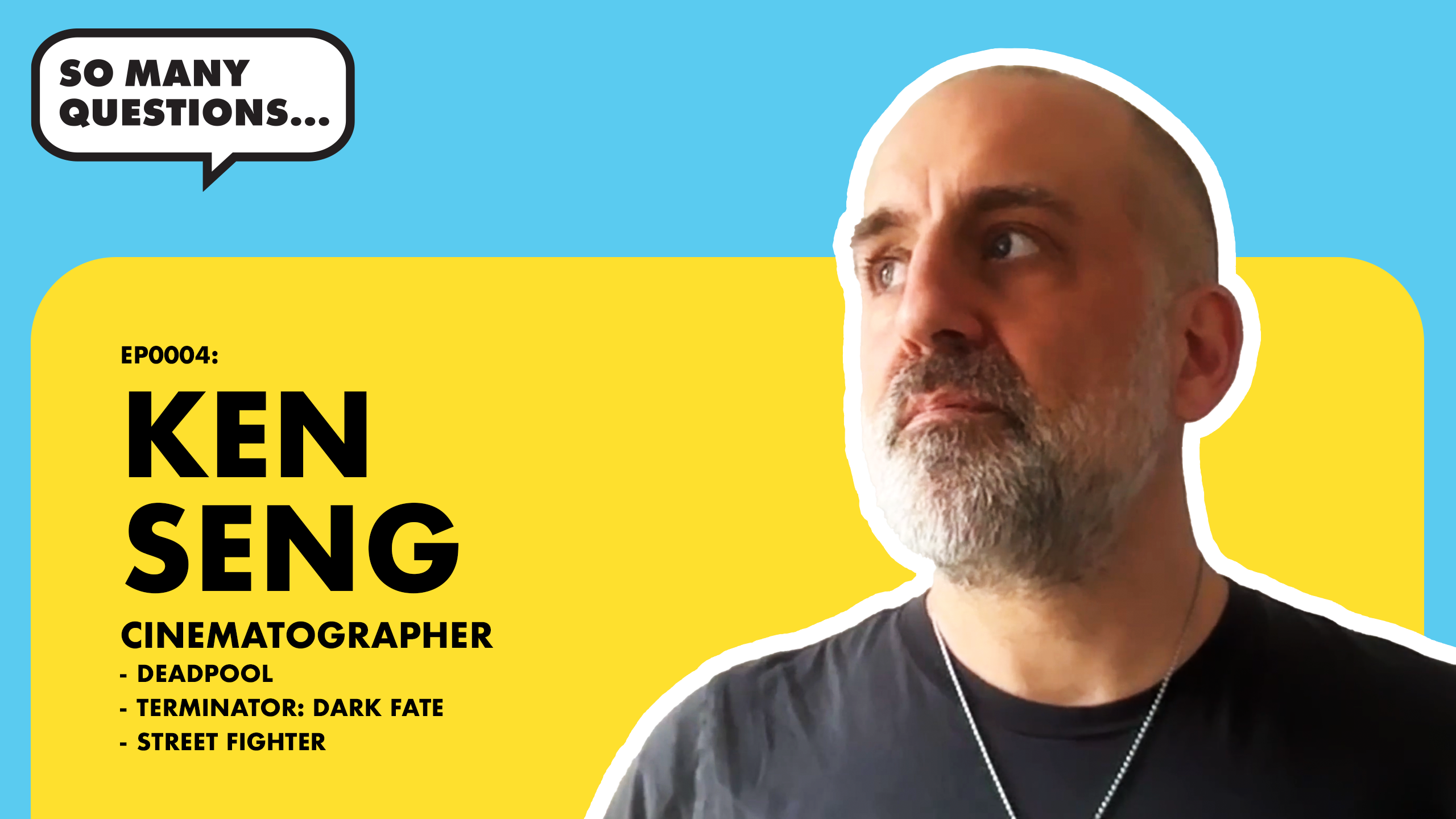
Episode 0004: Ken Seng
Director of Photography Ken Seng on Deadpool, Street Fighter, IMAX-scale action, French New Wave roots, and how craft, collaboration, and risk make film unforgettable.
When Ken Seng is watching an actor perform, he has his eye pressed to the eyepiece of a film camera. What he sees is not just a scene being recorded. It is a moment being shaped.
Ken is a Director of Photography. His credits include the first Deadpool, Terminator: Dark Fate, and the Street Fighter film he was shooting in Australia when we spoke. He has been making films his entire adult life, and one of the things that makes him interesting to talk to is how clearly he understands the difference between doing something skillfully and doing something artistically. They are not the same thing, even when they happen at the same time.
Here, we draw on that conversation. Not as a technical manual for aspiring cinematographers, but as an exploration of what it actually means to look at a story and decide how it should be seen.
What cinematography actually is
Most people understand, in a general way, that a film has a “look.” Some movies feel cold and blue. Some feel warm and saturated. Some shake with handheld urgency. Some glide with mechanical precision. You feel the difference even if you can’t name it.
What you may not know is that all of those choices belong to the Director of Photography.
It’s a director of photography’s job to interpret the script with the director
Ken explained in our conversation, “we are responsible for executing the photography of the film. We’re in charge of all the visuals, all the lighting, all the rigging, all the camera work and the look of the film in the end.”
That is a sweeping scope. A DP does not just point a camera. They build a visual world. They decide which lens makes a character feel vulnerable and which one makes them feel powerful. They decide whether a scene should feel handmade and messy or slick and constructed. They work with color, texture, light, shadow, movement, and pace to shape how an audience feels about everything they are watching.
And they do this in service of something larger. The story.
The way a story gets seen changes the story itself
This is the part that people who don’t make films often miss. Cinematography is not decoration applied to a finished story. It is part of how the story is told. The decisions a DP makes about how to film something are also decisions about what that something means.
Ken talks about this in terms of guardrails: rules he sets at the beginning of a project to give the visual language consistency and intention. “Whenever we’re with this character, we only use wide lenses close to them. We are only handheld in these kinds of scenes. These scenes we’re going to use more robotic crane type movements.”
Those are not arbitrary preferences. Wide lenses distort perspective slightly, pushing the edges of the frame outward, giving a sense of unease or immediacy. A handheld camera introduces motion and instability, suggesting vulnerability or urgency. Robotic movement is precise and controlled, and it creates a very different emotional register. The rule becomes a language. The audience learns it without knowing they’re learning it.
Lighting works the same way. “If I under light myself with red light and I use a zoom lens pushing in on me, we all know what that’s going to do emotionally. And then if I use a beauty light from a window, that creates another set of emotion.” He is not just describing techniques. He is describing how to speak to an audience in a language they understand at the level of feeling.
This is cinematography as art. Not as craft performed competently, but as meaning made visible.
The difference between craft and art in filmmaking
Ken draws a distinction here that is worth sitting with, because it is honest and a little uncomfortable for anyone who has spent a long time getting good at something.
Craft, he says, is like tools. It is the 10,000 hours. It is knowing that if you put the camera on a certain side and light from the other side, you will get pleasing images. It is the accumulated knowledge of what works, what communicates what, what the conventions are and why they exist. Film school teaches this. There is value in it. You cannot throw away rules you have never learned.
“I think craft is the experience of doing things repeatedly over and over again. And so yes, it’s critical. And it takes experience to become a craftsman.”
But then Ken says something unexpected. He says he has had to spend years unlearning what film school taught him.
I’ve had to unlearn convention and I’m constantly reminding myself to strip away the rules and expectations of the way that we should do things.
The goal, he says, is to have the full toolbox of craft available and then to consciously throw it aside. To start fresh. To ask: what if this scene was not solved the way I know how to solve it? What if I didn’t know how to do this?
He reaches for an image that is both funny and precise: “a child painting a beautiful Jackson Pollock type finger painting, could be like the most beautiful thing you’ve ever seen and you don’t know why.”
That is what art does. It produces a response that precedes understanding. You feel something before you can name it. And a DP who is only working from craft will produce work that is technically accomplished but emotionally legible in a way that gradually loses its ability to surprise you.
How collaboration shapes the image
Something else Ken makes clear is that a DP never makes these choices alone. Filmmaking, as he describes it, is relentlessly collaborative. The visual world of a film is the result of many people bringing ideas into conversation with each other.
The director brings their understanding of the story and a year or more of thinking about it. The production designer has already been interpreting the script, working out the architecture and environment and texture of the physical world the characters inhabit. The costume designer, hair and makeup, and visual effects supervisor all contribute elements that the camera will then need to make sense of. On an action film, the stunt coordinator is a central creative partner.
“The director is taking all these incredibly talented creative people and sort of unifying those ideas into one concrete, unified idea and concept.”
Ken’s role in this is to receive all of that and turn it into images. He is not the sole author of the visual language. He is the one who makes it cohere and puts it through the camera.
The best collaborations, he says, are the ones where there is no ego and the best idea wins. “I might say, this is interesting, what do you think about this? And he might say, that’s a great idea, but I was thinking of this. And then we’ll sort of start working off of each other.” When that exchange is working, the result is something neither person could have made alone.
Seeing versus recording
There is a moment Ken describes that stays with me. He is talking about working with actors, which he mentions almost as an afterthought, since when we spoke he was deep in prep for the film and thinking about logistics. But when he gets there, the language changes.
“There’s nothing better than having your eye on the eyepiece of a film camera and feeling this direct connection and watching an actor do some amazing performance. And it’s the most moving thing in the world.”
This is not the language of someone talking about technique. This is someone describing why they do the work.
A DP is looking at something real. A performance. A moment. Something that is happening in time and will not happen again in exactly that way. Their job is to be present to it, to see it clearly, and to make choices in real time that honor what is happening in front of them. That is not a skill you can reduce to a checklist.
It requires attention. It requires taste. It requires knowing your craft well enough that you can stop thinking about it.
Why the format changes what you feel
Ken has a strong view about where films should be seen, and it is worth taking seriously as an aesthetic position and not just a business opinion.
He believes that cinema changes the experience of a film in ways that are not entirely explicable but that are real. “There’s something about the image being bounced off of something and shot back onto you that I feel like it’s like reading a book on paper as opposed to reading something on an iPad. It imprints onto your brain in a way that you remember it and it stays.”
This matters for cinematography as art because it means that part of what a DP is doing is making something for a specific experience of reception. The choices Ken makes on a large-format IMAX production are made for a room with a massive screen, incredible sound, and an audience that has no other option but to pay attention.
“I am not shooting this movie for someone to watch it on an iPhone,” he says flatly. “And I’m not thinking about that at all, honestly.”
That is not stubbornness. It is a commitment to a particular kind of art, made at a particular scale, for a particular kind of encounter. The constraints of the theatrical experience are part of what gives the visual choices their meaning.
What this is asking of the audience
There is something Ken’s way of talking about his work implies, without quite stating it. Cinematography as art requires something from the person watching.
Not expertise. Not education. Not the ability to identify a lens or describe a lighting setup.
It requires presence. The willingness to be in the room, to be affected, to let the image do something to you before you decide what to think about it.
Ken talks about meditation in a way that connects to this. He meditates, he says, because it helps him notice when he is on autopilot. When he is solving problems with habit rather than attention. When he is reaching for the familiar solution instead of the true one. “Am I always good at it? No. Is it something I’m constantly working on? Yes. It’s part of my inner dialogue every single day.”
That is the same practice an audience brings to a film when they are really watching. Not consuming. Watching.
When the two meet, when a DP who is paying attention makes images for an audience who is paying attention, something happens that is difficult to describe but not difficult to feel.
That is cinematography as art. And it is not separate from the story. It is how the story reaches you.
Takeaway
Cinematography is not what you see. It is how you see it, and why that matters.
When Ken Seng talks about his work, he is not describing a technical service applied to a finished story. He is describing a form of attention, a practice of looking, that shapes what the story actually is for the person watching. If you want to understand more about how visual storytelling works and why the art that moves you tends to be made with this kind of intentionality, the episode with Ken is a good place to start. You can listen to Episode 4 with Ken Seng here.
FAQs
Kendall Guillemette | Mar 15, 2026