Surrendering Outcomes in Creative Work: The Joy Is in the Making
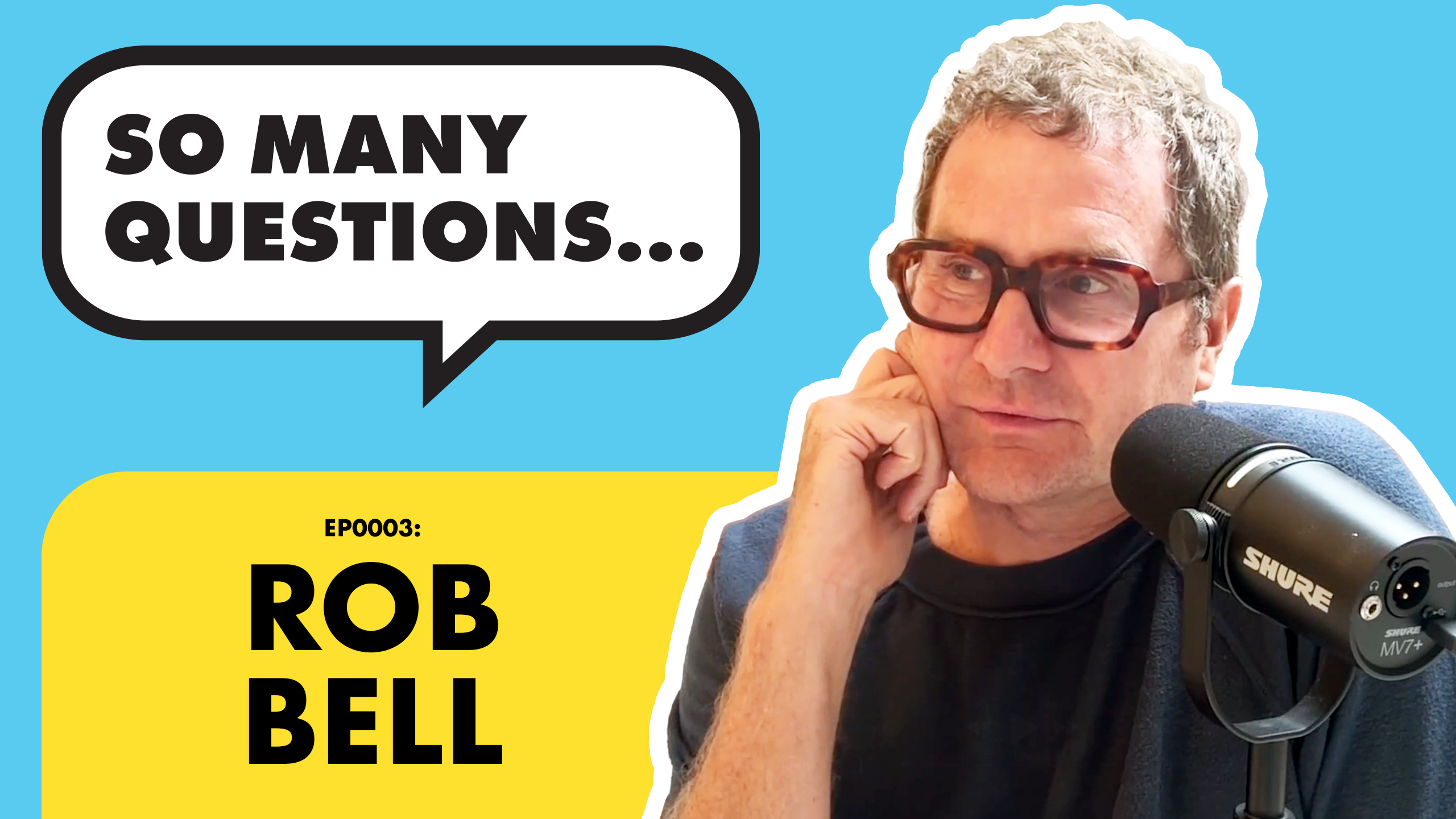
Episode 0003: Rob Bell
Rob Bell interview on So Many Questions to talk creativity, sermons as art, vulnerability, and how suffering shapes what we make.
You finished the thing. You sent it out. And then you waited—refreshing, watching, measuring—wondering if it landed.
Most of us know the feeling that follows: a quiet deflation when the response doesn’t match what you imagined. The project you worked hardest on gets the least attention. The thing you threw together in an afternoon catches fire. Nothing about the outcome correlates with what you put into it. And so the question becomes: why do you keep making things?
Rob Bell has thought about this for decades. Across 14 books, 400 podcast episodes, and a career that’s looked different in almost every chapter, he keeps coming back to the same idea: the joy is in the making. Surrendering the outcome isn’t resignation—it’s the only way to stay fully present in the work.
Why creative process over results matters
When you’re focused on the result, you’re not actually in the work. You’re hovering above it, evaluating it before it’s done, wondering how it will land instead of where it wants to go next.
This isn’t just a philosophical problem. It’s a practical one. Work made primarily to produce a specific outcome tends to be tight, defensive, and safe. The creator is protecting something—their reputation, their effort, their sense of whether this was worth doing. That protectiveness shows up in the work, and audiences feel it.
Work made from genuine engagement with the process tends to be the opposite. It takes risks. It surprises the person making it. It carries the energy of someone actually present in what they’re doing. That’s what people respond to—not polish or careful positioning, but presence.
There’s also the question of sustainability. If your measure of whether creative work is worthwhile depends entirely on how it’s received, you’ve handed the keys to everyone except yourself. Every quiet launch, every indifferent review, every piece that doesn’t perform becomes a reason to stop. The process orientation inverts this. The work was worth doing because you did it. What comes after is genuinely a different thing.
The difference with process-focused work
This isn’t about being indifferent to your audience or pretending you don’t care how things land. You can be fully invested in the work and hold its reception loosely at the same time.
The distinction is timing. Being focused on process means your full attention is on what the work is trying to become—not on what you’re trying to get from it. The evaluation comes later. The making is its own thing.
Rob Bell talks about this as being “fully invested while holding results loosely.” That’s a harder balance than either extreme. Detachment is easy. Obsession is easy. Presence without attachment is the actual practice.
Signs you’re outcome-focused
- You feel creatively energized only when a piece is getting traction
- You find yourself shaping work around what you think will perform rather than what interests you
- You abandon projects before finishing them because you’ve already decided they won’t work
- You struggle to enjoy the making when no one is watching
- You compare your output metrics to others more than you compare your ideas
- The parts of the process you like least are also the parts you can’t skip
- You feel more relief than satisfaction when something ships
What to do instead
1. Ask what the work wants to become. Louis Kahn, the architect, was known for asking: what does this building want to be? It sounds strange until you try it. When you’re stuck or shaping something to a predetermined outcome, stop and ask the question. You already have more information than you think—the work has been telling you where it wants to go.
2. Notice “should” when it appears. According to Rob Bell, “should” is an energetically loaded word that will rarely get you anywhere interesting. It implies an outside authority—someone or something watching and judging. When you catch yourself thinking “this should be more of this” or “I should have done it differently,” trace it back. Whose expectation is it? Often it has nothing to do with the work.
3. Tend the seeds in the backyard. Bell describes creative ideas as seeds in a backyard—you don’t force them to grow, you tend them and notice what emerges. Keep a running list of what’s pulling your attention. Revisit it. The ideas that keep showing up without effort are usually the ones worth pursuing. Not every seed becomes something—that’s part of the deal.
4. Set time aside that isn’t about output. This is where the work actually comes from. Some of it looks like rest. Some of it looks like walking or driving or making coffee in a particular way. Bell practices stretching and Tai Chi before sitting down to create—not because it produces anything, but because he’s learned that “an hour in a good place is worth who knows how many hours stretched, repressed, distracted, tired.” Your best making happens when you’re present, not when you’re grinding.
5. Finish things, then let them go. The finishing matters. Abandoned projects don’t teach you what completed ones do. But once something is done and shipped, your relationship to it changes. You’re not its guardian anymore. You did the work. What happens next is a different conversation—interesting, worth paying attention to, but separate from the making.
6. Track your own engagement, not the metrics. After you finish something, ask: was I actually here while I was making this? Did I follow something that surprised me? Did I learn something I didn’t know at the start? These are better signals of healthy creative practice than any dashboard.
An example from the work
Rob Bell’s book Love Wins generated what he describes as an absurd amount of backlash—death threats, organized campaigns, people enraged in a way that, from the outside, looked genuinely out of proportion to a book about theology. He could have been devastated. He could have stopped writing.
Instead, he says he found it clarifying. “Blessed are those who are in on the joke.” Extreme reactions—positive or negative—are rarely about you. They’re about what the work touched in the reader, the viewer, the listener. When you understand that, you realize you were never actually in control of any of it. You were only ever in control of the making.
He also points to the creative career trajectory itself: punk band, pastor, author, podcaster, workshop facilitator, musician again. No five-year plan. No single outcome he was building toward. Just following what seemed alive next. The thread connecting it all is 34 years of showing up to the process, not managing a brand or optimizing a path.
That continuity—showing up to make things, repeatedly, without controlling where it leads—is what a creative life looks like from the inside.
Source: Rob Bell interview, So Many Questions… podcast, Episode 3
FAQs
Takeaway
The work you do in the making doesn’t disappear when the project ships. It accumulates. It sharpens your instincts, builds your capability, and leaves residue in everything you make next. Focusing on creative process over results isn’t a consolation for projects that don’t perform—it’s the actual engine of a creative practice that lasts. Make the thing fully. Then let it go and make the next one.
Kendall Guillemette | Feb 16, 2026