Making Peace with Creative Criticism: A Guide to Vulnerability in Your Work
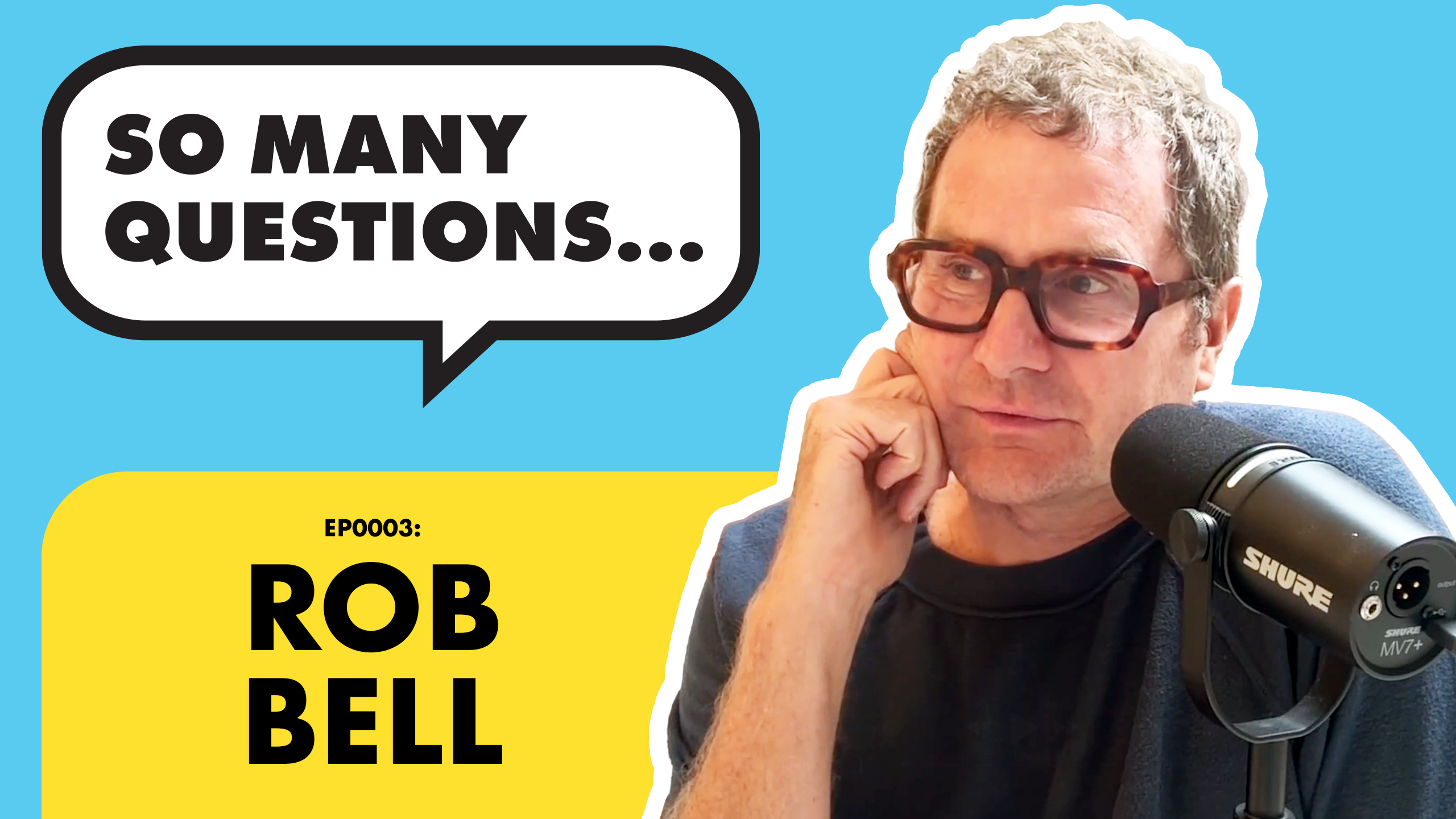
Episode 0003: Rob Bell
Rob Bell interview on So Many Questions to talk creativity, sermons as art, vulnerability, and how suffering shapes what we make.
You made something. You put it out into the world. And someone hated it.
Maybe they said so politely. Maybe they wrote a review you can still recite word for word. Maybe their silence was the loudest response of all. Whatever form it took, the sting of creative criticism lands somewhere deep and it stays.
Most advice about dealing with creative criticism tells you to develop a thick skin. To not take it personally. To separate yourself from your work. But that’s exactly the wrong approach. What if learning to stay open, vulnerable even, is what actually gets you through?
Why creative criticism hits differently
Criticism of regular work stings. Criticism of creative work can feel like a verdict on who you are.
When you write, paint, sing, speak, or build something from your inner life, you’re not just presenting a product. You’re offering a part of yourself. A draft of a novel carries your fears about what stories are worth telling. A first podcast episode carries your uncertainty about whether your voice deserves to be heard. The creative act is inherently personal, which means the response to it is personal too. Whether you want it to be or not.
Vulnerability is the engine of the whole thing. Love itself. It’s risk all the way down.
This is why the standard advice falls flat. “Don’t take it personally” assumes there’s a clean line between you and your work. For most creative people, there isn’t one. The question isn’t how to stop caring. The question is how to care deeply and still keep going.
The difference between useful and useless criticism
Not all creative criticism is the same. Learning to tell them apart is a foundational skill.
Useful criticism is specific. It addresses what the work does or doesn’t do. It comes from someone who engaged with what you actually made. Even when it’s harsh, there’s something actionable in it. A story that drags in the middle. A design that’s visually confusing. An argument that doesn’t hold up. This kind of feedback is a gift, even if it doesn’t feel like one.
Useless criticism tells you more about the critic than the work. It’s vague (“this isn’t my thing”), ideological (“I don’t agree with this perspective”), or disproportionate (rage over a relatively modest creative choice). It often arrives from people who haven’t fully engaged with what you made, or who are reacting to what they imagined you meant.
The problem is that both kinds arrive in the same emotional package: as rejection. Your nervous system doesn’t sort the mail. So the first skill in making peace with creative criticism is learning to do what your nervous system can’t—look at the source, look at the specificity, and decide what’s actually worth carrying.
Signs you haven’t made peace with creative criticism
How do you know this is something you need to work on? A few patterns to notice:
- You’ve stopped sharing work, or you share it only with people you know will approve
- You spend more time imagining negative responses than making the next thing
- You check feedback compulsively—reviews, comments, metrics—in the hours after publishing
- A single negative response can cancel out a dozen positive ones
- You’ve abandoned a creative project after one round of criticism, even when the work had real potential
- You preemptively soften your work before sharing, removing the parts that feel most like you
- You find yourself arguing with critics internally for days after reading a review
Any of these sound familiar? You’re not alone. They’re common responses to the vulnerability that creative work demands.
What to do instead: five ways to stay open without getting crushed
1. Sit with the discomfort before you respond to it
The immediate reaction to criticism is rarely the useful one. Before you dismiss it, defend yourself, or spiral, give it 24 hours. The emotional charge tends to settle, and what’s left after that is usually clearer—both about what the critic actually said and about whether any of it is worth taking in.
This isn’t suppression. It’s patience. You’re not trying to feel nothing. You’re trying to feel it and then look at it clearly.
2. Separate “I don’t like this” from “this is wrong”
A reader not connecting with your work is not evidence the work is bad. Taste is not a verdict. A genre isn’t for everyone. A style won’t resonate universally. When someone tells you they didn’t enjoy something, that’s useful information about their preferences—not a ruling on your work’s worth.
Train yourself to hear the difference between “this didn’t work for me” and “this is broken.” The first is a data point. The second is a claim that needs evidence before it deserves your attention.
3. Find the grain of truth without swallowing the whole thing whole
The most generative use of critical feedback is surgical. You’re not looking to accept or reject it wholesale. You’re looking for the useful part.
Is there a specific observation buried in the criticism that actually touches something real? A sensitivity the critic hit by accident? An aspect of the work you weren’t fully sure about yourself? Take that. Leave the rest.
4. Understand that extreme reactions often have nothing to do with you
When criticism tips into the disproportionate—anger, cruelty, fixation—it usually signals that something in your work touched something uncomfortable in the critic. Strong reactions to creative work are almost always about the person reacting, not the person who made the thing.
This is hard to remember in the moment. But it’s a perspective worth practicing. The critic who sends a hostile message about your essay isn’t responding to the essay. They’re responding to something it stirred up in them. That’s not your burden to carry.
5. Keep making things anyway
The only permanent response to creative criticism is the next piece of work. Not a defensive rebuttal. Not a modified version designed to appease everyone. The next thing. Made honestly, with the same willingness to be seen that got you into this situation in the first place.
The creative life is not a destination you reach once the criticism stops. The criticism doesn’t stop. What changes is your relationship to it.
From the So Many Questions… archives
In a conversation on So Many Questions…, author and speaker Rob Bell talked about getting what he called “shredded” at 22—one of his early creative attempts met with sharp criticism from people he respected. Rather than retreating, he took that experience as a kind of initiation.
What Bell describes isn’t a strategy for becoming immune to criticism. It’s a philosophy of accepting that criticism is part of the deal when you make anything that matters. The willingness to be vulnerable isn’t a character flaw you need to fix. It’s the condition that makes real creative work possible.
He also offered a perspective on extreme criticism—the kind that goes well beyond disagreement into something almost theatrical. “Blessed are the ones who are in on the joke,” he noted. When people respond to creative work with outrage disproportionate to what was actually made, the creator who can find humor in that absurdity instead of collapsing under it has an enormous advantage.
That’s not dismissiveness. It’s a kind of hard-earned clarity: this is not that much about me.
(Source: So Many Questions… Episode 0003 — Rob Bell)
FAQs
Takeaway
Dealing with creative criticism never becomes entirely comfortable. Tßhat’s not the goal. The goal is to build enough perspective that criticism doesn’t determine whether you keep going. The work you’re most afraid to share is often the work that matters most. Vulnerability isn’t the obstacle to creative life. It’s the entry point.
Kendall Guillemette | Feb 16, 2026