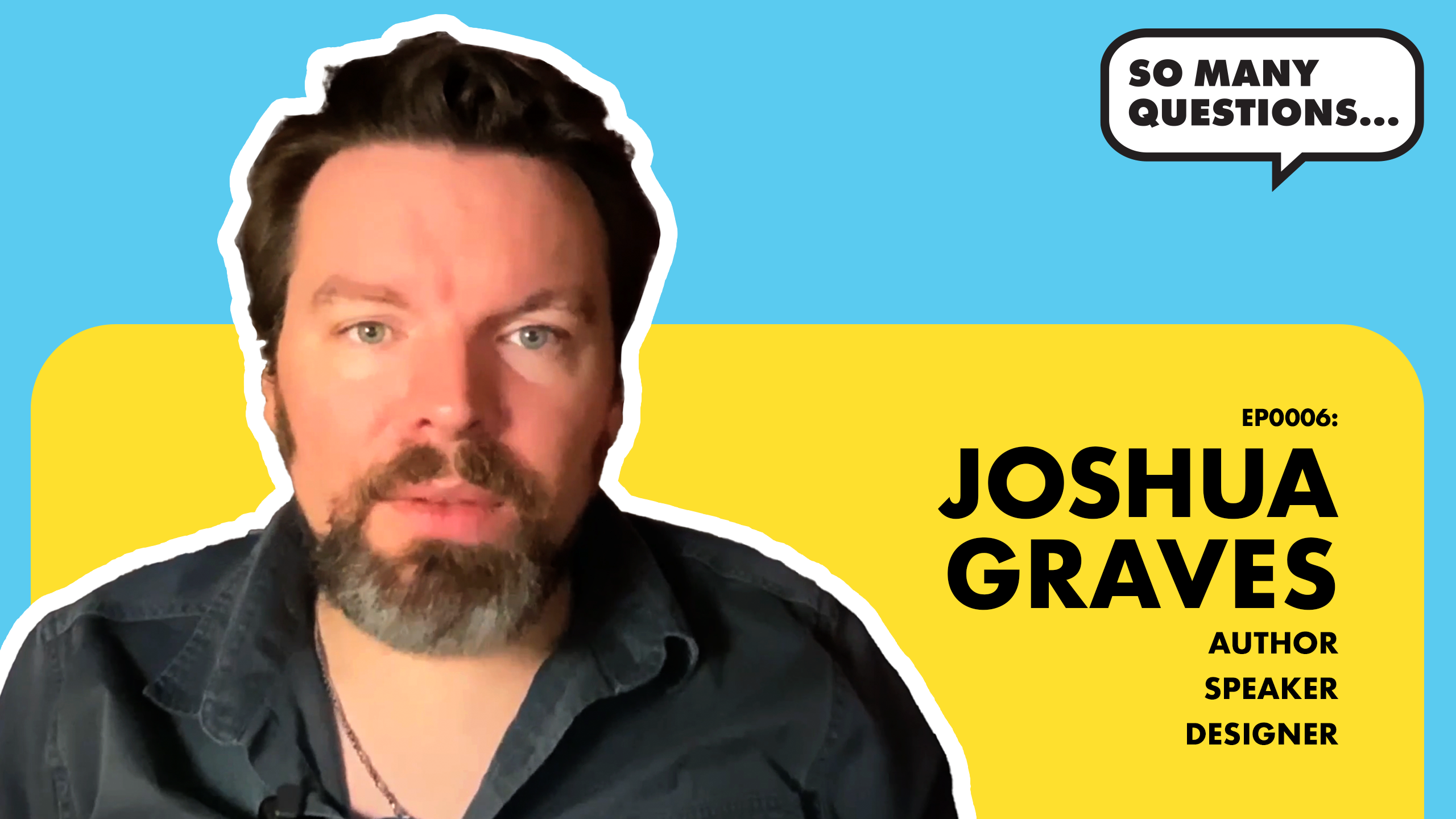
Episode 0006: Joshua Graves
Author Joshua Graves joins So Many Questions to explore difficult conversations, power dynamics, listening skills, and practical tools for healthier communication.
Art and the human experience
Often, art arrives in our lives through everyday circumstances. In a poster you saw and keep thinking about. A song that makes a long drive feel shorter. A painting you don’t fully understand but can’t forget.
Art doesn’t exist to explain the world to us. It sits with us, inside it. This space is for exploring art as a human responses to living, feeling, and paying attention. Art is not something to decode, rather its something to bathe and marinate in. To participate in.
What we mean when we say “art”
Art is often discussed as output. Finished work. Products. Objects hung, streamed, sold, or shared.
But lived art is something else.
It’s the sketch that never becomes anything. The design choice that changes how a room feels. The image that names an emotion you didn’t have language for.
In this context, art includes:
- visual art
- design
- illustration
- creative process
- unfinished ideas
Art is not defined by prestige here. It’s defined by attention.
Where art begins
Art doesn’t start in museums. It starts in noticing.
Before technique, there is curiosity. Before style, there is response. Someone sees something and feels the urge to answer it.
Historically, art has been tied to ritual, storytelling, labor, protest, devotion, and play. Its forms change, but its function remains familiar. Art helps us process what it means to be alive at a particular moment in time.
Even now, when art is entangled with platforms, algorithms, and markets, its original impulse remains surprisingly intact.
Someone trying to say, this mattered to me.
Why art still matters
Art slows us down when the world asks us to move faster.
It gives shape to experiences that don’t resolve neatly. It holds contradiction without asking us to choose a side. It reminds us that meaning is often felt before it is understood.
In a culture that rewards clarity and productivity, art offers something less efficient and more honest.
Ambiguity. Texture. Presence.
This is not nostalgia. It’s necessity.
Art and design
Design sits at the intersection of art and utility.
It shapes how we move through spaces, websites, objects, and ideas. Good design disappears. Bad design demands attention. Both influence how we feel.
Design choices are never neutral. They reflect values about ease, beauty, access, and control.
Here, we explore design as:
- a form of care
- a language of restraint
- a quiet power shaping everyday life
Not trends. Not tools. The human impact.
Art and identity
Art has always been a mirror.
We see ourselves in it, even when it wasn’t made for us. We also use it to try on selves we don’t yet know how to inhabit.
For artists and audiences alike, art can be:
- a place to belong
- a way to resist being simplified
- a method of self-understanding
In a world that often asks for coherence, art allows multiplicity.
You don’t have to be one thing inside it.
Art and labor
Making art takes time. Often more time than it’s given.
The modern art world asks creators to be visible, consistent, and productive. To turn process into content. To turn feeling into output.
This raises quiet tensions:
- between making and sharing
- between survival and integrity
- between pace and depth
This space doesn’t offer solutions. It offers room to name what’s hard without reducing art to hustle.
Common misunderstandings about art
Art is for experts. Most art is made by people trying to understand something, not explain it.
Art should be easy to interpret. Some experiences resist clarity for a reason.
Art has to be useful. Its usefulness often arrives later, sideways, or not at all.
Art does not need permission to exist.
How to live with art
You don’t need credentials to engage with art.
You only need time, curiosity, and the willingness to feel something without immediately categorizing it.
Living with art might look like:
- returning to the same piece over years
- noticing what changes in you, not the work
- letting confusion be part of the experience
Art doesn’t demand conclusions. It asks for presence.
Looking forward
Art will keep changing. Mediums will shift. Platforms will rise and fall.
What won’t change is the human impulse to make sense of being here.
To leave traces. To respond. To say, this is what it felt like.
This space exists to honor that impulse. Without rushing it. Without explaining it away.
Each path opens differently. You don’t have to choose just one.