You Don't Need Oil Paint to Live a Creative Life
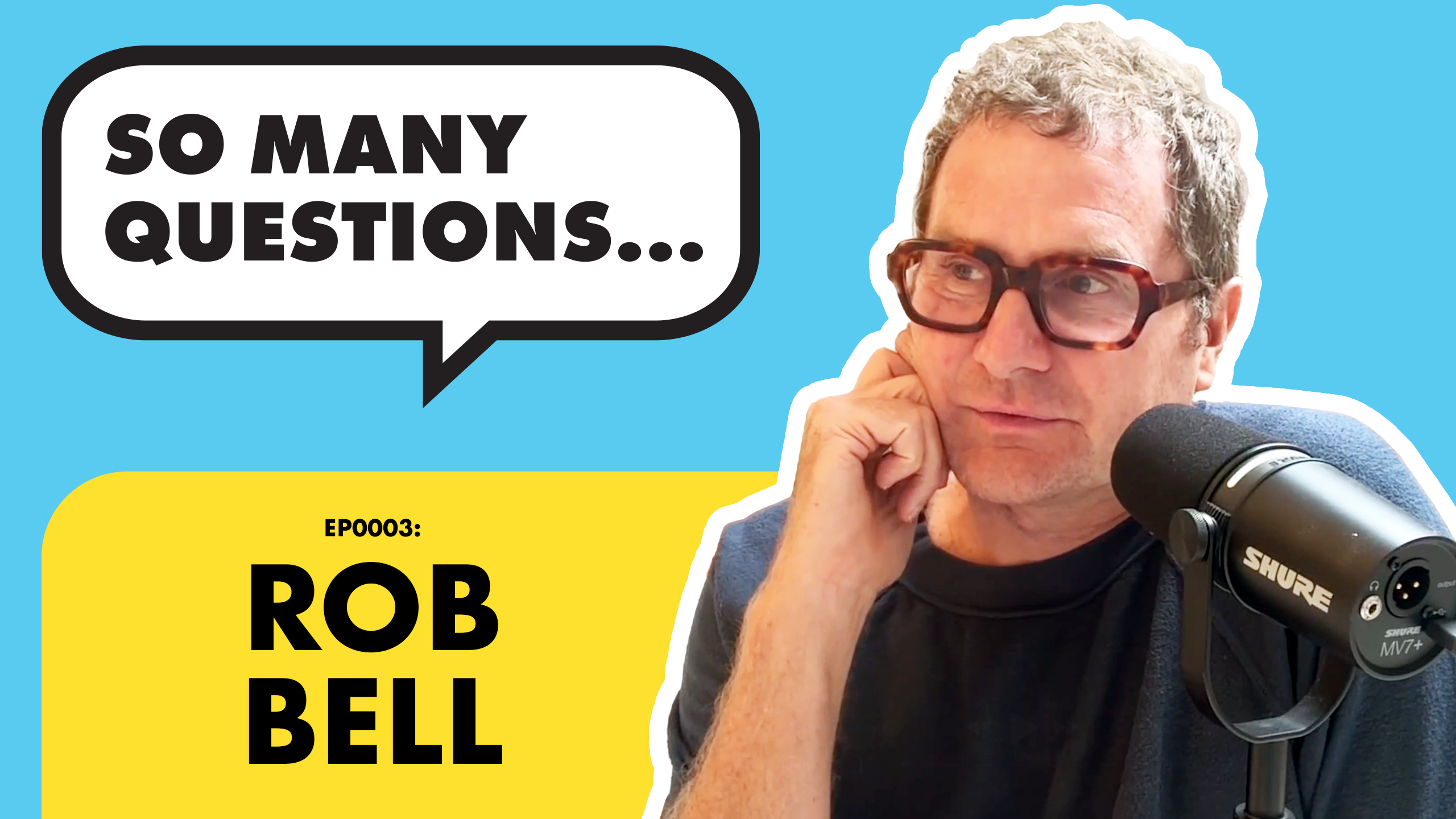
Episode 0003: Rob Bell
Rob Bell interview on So Many Questions to talk creativity, sermons as art, vulnerability, and how suffering shapes what we make.
Ask someone to name a creative person, and they’ll probably describe a painter, a musician, or a novelist. Creativity isn’t a specialized talent that only shows up with a paintbrush, a camera, or a guitar. It’s closer to a form of attention, the instinct to shape something toward an intention, and it shows up in ordinary decisions long before it shows up in a finished piece of art.
What Rob Bell means about everyday creation
Bell has spent decades moving between mediums: a band in his twenties, sermons he treats as an art form, then books, films, and a podcast. When Kendall asked him what makes someone creative, he skipped painters and sculptors entirely. He pointed to an accountant balancing a ledger, someone arranging their own calendar, a person restoring an old car in their driveway.
You’re hard-pressed to find somebody who, with some minimal self-inquiry, can’t quickly discover all the creation going on. Remodeling an old car. The garden beds in the backyard. These are what we do.
A minute later, Kendall brought up something even smaller: the fact that everyone folds laundry differently. Bell didn’t wave it off as too minor to count. He laughed, agreed, and Kendall named what was actually happening. That’s not necessarily art, but it is participating in the same creative instinct.
Why we gatekeep the word “creative”
Most people reserve “creative” for anyone who produces a finished, sellable object: a painting, a song, a film. Bell runs into that gatekeeping directly, from people who tell him they’re “not creative” like he is. His response isn’t a pep talk. It’s a set of very specific, ordinary questions.
What do you do when you wake up in the morning? And then what? And then what?
The point isn’t that everyone secretly makes art. It’s that everyone is already shaping their day according to some instinct, and that instinct, paying attention to how you do something and choosing to do it your way, is the same one that eventually produces a painting or a song. The medium is just further downstream.
The creative impulse survives a career change
Jonny Hoffner, co-founder of the wedding photography studio Paper Antler and the golf apparel brand Good Lion, didn’t study art in college. He majored in philosophy, which he jokes is “a fast path to unemployment,” and fell into photography afterward almost by accident, assisting two working photographers he found through Craigslist.
What kept him there wasn’t a plan. It was how much he liked the unpredictability of shooting weddings, adapting on the fly to whatever a room, a couple, or the weather handed him that day.
You have very little control of most everything, and I actually really liked that from a creative standpoint, because you have to adapt and work on the fly.
Years later, that same instinct showed up somewhere nobody would have predicted: golf apparel. During a round of golf with a college friend, Hoffner hit a blind shot off the tee. His friend told him it wasn’t safe, but it was good, an echo of the line about Aslan from the Narnia books Hoffner had just finished reading to his kids. That single phrase became the foundation of Good Lion, the golf apparel brand he built around it: good over safe.
Hoffner’s career doesn’t look like a straight line. It looks like the same underlying instinct, adapting on the fly and making something with intention, resurfacing first in photography and then in a completely different medium: apparel and brand-building, despite a philosophy degree and a full change of industry in between.
Noticing the creative acts you’re already doing
Before starting a “big” creative project, Bell suggests a much smaller move: interview yourself the way you’d interview someone you admired, down to their coffee order or their shoes. Applied to your own life, that means paying attention to the parts of your day you already handle in a specific way, without being told to.
A few starting points:
- Ask what something is trying to become. Bell cites architect Louis Kahn, who would ask a building what it wanted to be before designing it. Apply the same question to a task, a room, or a message you’re about to finish on autopilot.
- Notice where you already do something “your way.” That habit, whatever it is, is evidence the instinct is active, whether or not you’d call the result art.
- Treat that habit as a deliberate choice. Small as it is, it’s the same muscle a painter or a musician is using at a larger scale.
None of this replaces making actual art, and Bell would be the first to keep painting, writing, and recording music anyway. But the instinct behind those things doesn’t switch on only when you pick up a paintbrush. It’s already running underneath how you live. You can hear the full conversations with Rob Bell in Episode 3 and Jonny Hoffner in Episode 8.
FAQs
Kendall Guillemette | Aug 16, 2026