How to Overcome Creative Block (When Nothing Feels Good Enough)
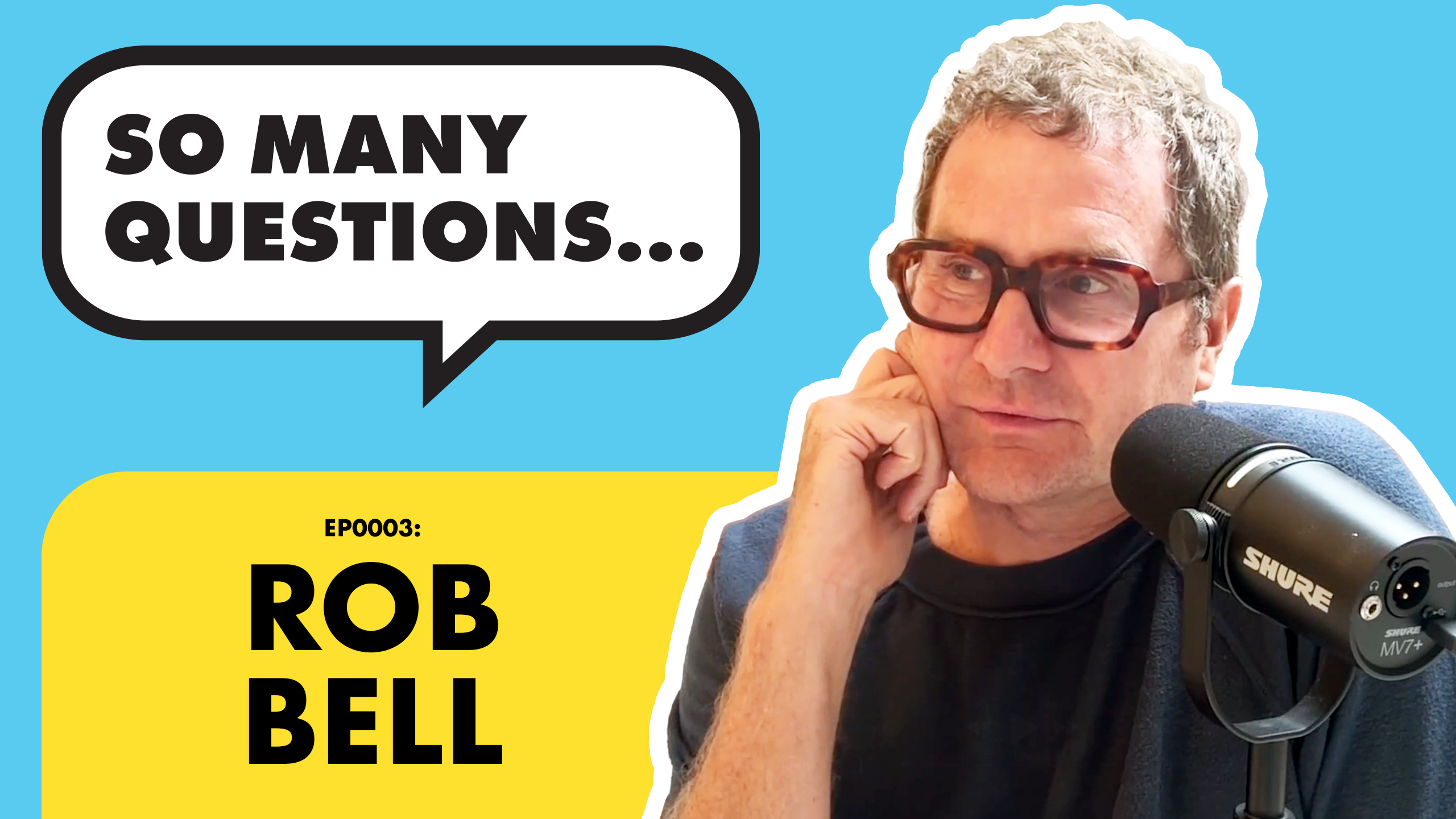
Episode 0003: Rob Bell
Rob Bell interview on So Many Questions to talk creativity, sermons as art, vulnerability, and how suffering shapes what we make.
You sit down to create. Open the blank page, set up the canvas, position the camera. Then the familiar feeling hits: nothing you make will be good enough. Every idea feels flat before you even try it. You start and stop a dozen times. Nothing survives contact with your internal critic.
This isn’t ordinary creative block. It’s the specific paralysis that comes from perfectionism. The voice that says your work won’t matter, won’t be original, won’t be as good as what’s already out there. So why bother starting?
This type of creative block is exhausting because you’re not actually stuck for ideas. You’re stuck believing none of your ideas are worth pursuing. The problem isn’t a lack of creativity. It’s an excess of self-judgment that kills everything before it has a chance to live.
Why creative block matters
Creative block that stems from “nothing feels good enough” is particularly damaging because it compounds over time. The longer you stay blocked, the more evidence you collect that you can’t create. Each abandoned project becomes proof that you were right to not try.
The real cost isn’t the work you don’t make. It’s how the block changes your identity. You go from “I’m a creator having a hard time” to “I’m not really creative anymore.” That shift can stick for years.
Rob Bell talks about this in terms of presence and creative flow: “The mind worrying about what about. Noticing how mind creates problems that don’t exist now.” When you’re blocked by perfectionism, you’re not in the present moment of making. You’re in a future where you’ve already failed.
The block becomes a self-fulfilling prophecy. You don’t create, so you don’t improve. You don’t improve, so everything you attempt feels inadequate. The cycle deepens.
The difference with this type of creative block
Not all creative blocks are the same. Some blocks come from burnout, or lack of inspiration, or being genuinely stuck on a technical problem. Those are real and valid.
This particular block is different. You have energy. You have ideas. You even have time. What you don’t have is permission to make something imperfect.
Ken Seng, director of photography on films like Deadpool, describes the tension between craft and creation: “Throwing away cinematography rules. Child’s finger painting versus learned technique. Starting new so things don’t become tired.”
The paradox is that knowing what good work looks like can trap you. You’ve developed taste. You can see the gap between what you want to make and what you’re capable of making right now. That gap becomes the block.
Beginners don’t have this problem. They don’t know what’s supposed to be good, so they just make things. Intermediate creators, the ones who’ve developed enough skill to judge quality but not enough to consistently execute at that level, get stuck in the gap.
You’re not blocked because you don’t know enough. You’re blocked because you know too much about what you’re trying to do and not enough about how to quiet the judgment long enough to do it.
Signs of perfectionism-driven creative block
- You start projects enthusiastically and abandon them as soon as they feel ordinary
- You compare your rough drafts to other people’s polished final work
- You spend more time thinking about creating than actually creating
- You have detailed standards for what your work should be before you’ve made anything
- You feel anxiety or dread when you think about starting a new project
- You procrastinate with research, planning, or “getting inspired” instead of making
- You tell yourself you’ll start when you have more time, better tools, or clearer vision
- You critique your work while you’re still making it instead of after
- You feel like an impostor even though you have demonstrable skills
- You oscillate between grandiose visions and complete creative paralysis
How to overcome creative block when nothing feels good enough
1. Separate making from judging
The most effective intervention is temporal: make first, judge later. Not simultaneously. The creative part of your brain and the critical part don’t work well at the same time.
Rob Bell describes this as beginner’s mind: “Beginner’s mind in creative practice. Starting new each time while building craft muscles.” You bring your skills, but you approach the work with curiosity rather than predetermined standards.
Set a rule: no evaluation until you’ve completed a full draft or version. Make the whole thing, however rough, before you decide if it’s any good. This feels uncomfortable because you can see the flaws as you go. See them. Don’t fix them yet. Finish first.
This works because perfectionism thrives on incompletion. An unfinished project can always be improved in your imagination. A finished draft is concrete. You can actually evaluate it instead of just fearing it.
2. Lower the stakes radically
You’re blocked because the work feels too important. Every project carries the weight of proving you’re talented, original, worthwhile. That’s too much pressure for anything to survive.
Make deliberately low-stakes work. Give yourself permission to create something that doesn’t matter. Not everything has to be your masterpiece. In fact, most things shouldn’t be.
Make the thing for the sake of making it, not for what it might become or who might see it. Bell talks about this as surrender:
The joy is in the making and then you’ve surrendered the outcome. Being fully invested while holding results loosely.
Try making work you never intend to share. A sketch no one will see. A draft that won’t be published. A recording that stays on your hard drive. The point is the process, not the product.
Once the stakes are lower, the block often dissolves. You’re not protecting yourself from public failure anymore. You’re just practicing your craft in private.
3. Move your body when the block hits
Creative block lives in your head, but your body can interrupt it. When you’re stuck in the spiral of “this isn’t good enough,” physical movement breaks the pattern.
Move the body when feeling lost. Walking, surfing, hiking to let emotion pass like a wave.
The perfectionism that fuels creative block is an emotional state, not a rational assessment. Treat it like an emotion that needs to move through you. Walk. Run. Stretch. Dance. Clean your space. Do something physical that doesn’t require creative decisions. This isn’t procrastination. It’s a deliberate interruption of the mental loop.
Movement also helps because it returns you to the present moment. Perfectionism lives in the imagined future where you’ve already failed. Walking makes it harder to stay in that timeline. You’re just here, moving, breathing, existing without evaluation.
4. Set constraints that bypass perfectionism
Perfectionism flourishes in unlimited possibility. When you can make anything, everything feels like it could be better. Constraints remove that paralysis.
Ken Seng talks about creative guardrails: “Guardrails in cinematography. Setting rules like ‘wide lenses close’ or ‘handheld only here.’” These aren’t the rules you learned. These are artificial limitations you impose to force specific creative problem-solving.
Give yourself tight constraints:
- Make something in 15 minutes, not 15 hours
- Use only three colors, not your full palette
- Write 200 words, not a full essay
- Record one take with no editing
- Create with a deliberately limited toolset
Constraints work because they make “perfect” impossible. You can’t make a perfect sketch in 15 minutes. The goal becomes finishing within the constraint, not achieving some abstract standard of quality. That shift in goal unlocks movement.
5. Practice starting badly on purpose
Your block comes from needing to start well. What if you practiced starting terribly instead?
The first line of your essay: make it boring. The first sketch: make it actively ugly. The first recording: make it rough. Do this deliberately, as an exercise in defying the perfectionism.
This works for two reasons. First, it removes the pressure of the opening. You’re not trying to nail the beginning anymore. Second, it usually reveals that your “terrible” start is actually fine. Or that even if it is terrible, you can improve it once something exists.
Bell captures this mindset: “Creation arises within the vast expanse of formless spaciousness that exists within each of us. All creation is ongoing and you are its ongoing creation.” You don’t summon perfect work from nothing. You make rough work and shape it.
Starting badly on purpose gives you raw material to work with. Once something exists, your perfectionism can actually help by refining it. But it has to exist first.
6. Question the thoughts that create the block
The block feels like truth, but it’s actually a story. “This isn’t good enough” is a thought, not a fact. You can examine it the way you’d examine any other claim.
Bell references Byron Katie’s inquiry method: “What is the thought, is it true? Following it back to its cave. When I was seven I picked up this story.” Most perfectionism traces back to earlier experiences, often childhood, where you learned that your worth depended on performance.
Ask yourself:
- Is “this isn’t good enough” objectively true, or is it a feeling?
- Good enough for what, exactly? What standard am I using?
- Who am I comparing myself to, and is that comparison useful?
- What would I tell a friend who showed me this work?
- Am I judging the work itself, or my fear of how others might judge it?
Often the block dissolves when you realize you’re not actually evaluating your creative work. You’re trying to protect yourself from imagined criticism by never finishing anything that could be criticized.
7. Accept that vulnerability is part of the process
You’re blocked because creating feels risky. You’ll expose yourself. People might judge you. You might confirm your secret fear that you’re not as talented as you hoped.
Bell speaks directly to this: “Vulnerability in creativity. Opening yourself to criticism, making peace with negative reactions, learning early. Vulnerability is the engine of everything. Risk all the way down.”
The block isn’t protecting you from failure. It’s protecting you from vulnerability. But vulnerability is the price of creating anything meaningful. You can’t make work that connects with people without exposing something of yourself.
Making peace with this doesn’t mean enjoying criticism or becoming immune to judgment. It means accepting that if you create, you will be vulnerable. You can choose that anyway.
Bell describes his own experience: “Making peace with creative criticism early. Getting shredded at 22 and learning vulnerability is part of the work. This is not that much about me.” The criticism says more about the critic than about your work. But you only learn that by creating despite the fear.
The block keeps you safe from vulnerability. It also keeps you safe from connection, impact, growth, and the satisfaction of making something real.
FAQs
Creative block can last anywhere from a few days to years, depending on how deeply the perfectionism has taken root. The duration matters less than whether you’re actively working to move through it. If you wait for the block to lift on its own, it often doesn’t. But if you consistently practice the strategies above, creating despite the discomfort, most people see movement within a few weeks.
The key is recognizing that the block isn’t a fixed state. It’s a pattern you’re maintaining through specific thoughts and behaviors. Change those patterns and the block shifts.
There’s a difference between work that needs more skill development and work that’s being judged prematurely. If you’re genuinely at the beginning of learning a craft, focus on volume over quality. Make a lot of work. You’ll improve through repetition.
But if you have demonstrable skills and still feel blocked, the issue likely isn’t your capability. It’s your relationship with imperfection. Even skilled creators make plenty of mediocre work. The difference is they finish it, learn from it, and make the next thing.
“Good enough” is contextual. Good enough for what? A practice sketch doesn’t need to be gallery-ready. A rough draft doesn’t need to be publishable. Adjust your standards to match the stage of the work.
Realistic self-criticism happens after you’ve created something. You evaluate the finished work and identify specific areas to improve. It’s constructive and future-focused.
Perfectionism happens before or during creation. It stops you from finishing anything. It’s vague and self-focused (“I’m not talented enough”) rather than specific and work-focused (“this section needs stronger structure”).
If your criticism helps you make better work, it’s useful. If it keeps you from making any work at all, it’s perfectionism.
Yes. Judging yourself for being blocked just adds another layer of paralysis. “I should be creating” becomes “I should be creating and I also shouldn’t be blocked about it.”
Rob Bell’s question is useful here: “Would you just give yourself some fucking grace? We’re so hard on ourselves. What would it look like if kinder to ourselves?”
Creative block isn’t a moral failing. It’s a pattern. You don’t need to add shame to the existing discomfort. Treat yourself like you’d treat a friend who’s struggling. With patience, practical support, and acknowledgment that this is hard.
Then you have something concrete to work with. Bad work that exists is infinitely more valuable than good work that stays imaginary.
Ken Seng talks about learning through experience: “Things that don’t work versus things that work. Learning through trial and error. Scars teach us things you screw up.” You improve by making things, seeing what doesn’t work, and adjusting.
The fear that your work might be bad is keeping you from discovering what it actually is. Make it. If it’s bad, you’ll know specifically how. That’s information you can use to make the next thing better.
Perfectionism tells you to wait until you can make something good. Experience tells you to make something now and learn from it. The second path is faster and actually leads to growth.
Takeaway
Creative block that stems from “nothing feels good enough” is one of the most common and most solvable forms of creative paralysis. It’s not about lacking talent or inspiration. It’s about judgment arriving too early in the process and shutting everything down before it has a chance to develop.
The strategies above all work toward the same goal: getting you to make something, anything, despite the discomfort of imperfection. Separate making from judging. Lower the stakes. Move your body. Use constraints. Start badly on purpose. Question the thoughts. Accept vulnerability as part of the work.
As Rob Bell demonstrates through decades of creative output across multiple media, the joy really is in the making. The outcome matters less than you think. What matters is staying in the process, staying present, and continuing to create even when the internal critic says it won’t be good enough.
As Ken Seng shows through his evolution from perfectionist student to professional cinematographer, you need both craft and the willingness to throw away the rules. The block often comes from overvaluing the rules and undervaluing the act of creation itself.
Make the thing. It probably won’t be perfect. It doesn’t need to be. Finished and imperfect beats imaginary and flawless every single time. The only way out of the block is through it, one imperfect creation at a time.
Kendall Guillemette | Feb 24, 2026