Why Do We High-Five? The 1977 Dodgers Play That Started It All

Episode 0009: Ken Schultz - Outsports baseball writer
Gay sportswriter Ken Schultz (Outsports) on the Giants Pride Night controversy: Bible verse hats, MLB backlash, and Buster Posey's non-answer.
Most gestures fade into history without a witness. Nobody knows exactly when the first handshake happened, or who threw the first coin into a fountain. The high-five is different. It has a date, a stadium, and two players whose names you can look up.
On October 2, 1977, Los Angeles Dodgers outfielder Dusty Baker hit a home run against the Houston Astros. It was his 30th of the season, making the Dodgers the first team in major league history to have four players each hit at least 30 home runs in the same year. As Baker rounded third and headed for home, teammate Glenn Burke ran out to greet him with his arm raised straight over his head.
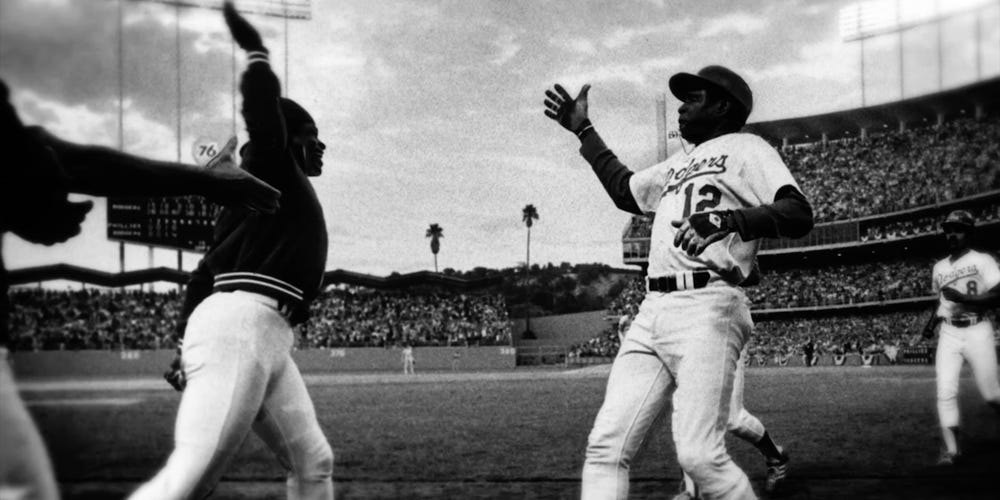
Baker had never seen the gesture before. He wasn’t sure what to do with it. So he jumped up and slapped Burke’s hand.
Why does the high five matter?
That single slap is the most credible starting point historians and sportswriters have found for the high-five. It didn’t spread because a company marketed it or a celebrity popularized it. It spread because it looked good on television, felt good to do, and gave players a way to celebrate that a handshake couldn’t match.
Baker and Burke kept doing it. Teammates picked it up. By the early 1980s, the gesture had jumped from the Dodgers dugout to other clubhouses, then to other sports entirely. Within a decade it was everywhere: playgrounds, offices, awards shows, greeting cards.
Most viral gestures don’t have an origin story this specific. Most also don’t have a co-inventor whose full story gets left out as often as Glenn Burke’s does.
The play itself
Baker’s home run came in the sixth inning off Houston starter J.R. Richard. It capped a historic offensive season for the Dodgers, whose lineup that year (Baker, Steve Garvey, Ron Cey, and Reggie Smith) became the first foursome of 30-home-run hitters on one roster. Burke was in the on-deck circle, waiting to bat next.
Different accounts describe Burke’s excitement slightly differently: some say he was celebrating the milestone, others say he was simply so happy for his friend that his arm shot up on its own. Either way, Baker’s decision to slap the raised hand rather than shake it, hug him, or ignore it is the detail that made the gesture repeatable. A slap takes less than a second. It requires no coordination beyond two people agreeing, in the moment, to do the same simple thing.
A 1990 Atlanta Journal column, written more than a decade after the fact, credited the pair directly: whenever Baker or Burke were pleased with a teammate’s play that season, they slapped hands overhead. The label “high five” came later, once the gesture needed a name to distinguish it from a regular handshake down at waist height.
The player most retellings leave out
Glenn Burke’s baseball career was short. He played for the Dodgers and later the Oakland Athletics between 1976 and 1979, and an early coach compared him to a young Willie Mays. But Burke was gay, at a time when no active major league player had ever said so publicly, and his time in the league was shaped by that fact as much as by his play.
According to Burke’s own account, Dodgers general manager Al Campanis offered to pay for an extravagant honeymoon if Burke would agree to get married. Burke, by his own telling, responded by asking, “To a woman?” He was traded to Oakland not long after, a move that reportedly left teammates and fans upset. In Oakland, manager Billy Martin treated him with open hostility. A knee injury pushed him out of the majors for good by 1980.
Burke came out publicly in 1982, three years after his last major league game, becoming the first former MLB player to do so. He went on to compete in gay softball and baseball leagues and won medals at the Gay Games. His later years were difficult: a car accident, a period of homelessness, a prison sentence, and an HIV diagnosis. He died in 1995 at age 42.
The high-five he helped invent went on to become one of the most universal gestures in the world. His name is far less well known than the gesture itself.
How the gesture spread
Sports gestures usually spread through imitation, and the high-five had ideal conditions for it. Baseball games are broadcast to huge audiences, celebrations happen constantly, and any gesture that reads clearly on camera gets copied fast by fans and other athletes.
By the early 1980s, college basketball had adopted it widely enough that some retellings credit a University of Louisville player from that era as a separate, unrelated originator. Most sports historians treat that as a parallel adoption rather than a competing invention: the gesture had already been circulating in baseball for several years by then.
From sports, the high-five moved into ordinary life the way successful gestures usually do: through television, through kids copying what they saw athletes do, and through sheer usefulness. It fills a specific social gap that a handshake doesn’t. It works for celebrating a shared win between equals, in a half-second, without needing any words at all.
What makes a gesture catch on
A few conditions helped the high-five spread as fast as it did:
- It requires no explanation. Anyone can see what to do the first time they see it happen.
- It reads clearly at a distance, which matters for anything that gets broadcast or photographed.
- It fills a gap other greetings don’t. A handshake feels too formal for celebrating a shared win; a hug takes too long.
- It scales down easily, from professional athletes to small children, without losing its meaning.
Compare that to a gesture like the fist bump, which some athletes and public figures adopted decades later partly as a lower-contact alternative during flu season and, later, the COVID-19 pandemic. The logic is similar: a small, clear, fast gesture that says the same thing a handshake says, adapted for a new set of practical concerns.
The takeaway
The high-five has one of the most precisely documented origins of any everyday gesture: a specific home run, a specific stadium, and two teammates who decided, in the moment, that a raised hand deserved a slap instead of a handshake. Dusty Baker went on to a long career as a player and manager. Glenn Burke’s story is more complicated, and more important, than the gesture he’s remembered for.
The next time you high-five someone, you’re repeating something two Dodgers teammates invented on the spot in October 1977, for reasons that had nothing to do with going viral and everything to do with genuinely being happy for each other.
FAQs
Related reading
If you’re curious about other gestures with documented origins, the handshake started as a way to prove you weren’t carrying a weapon, which makes an interesting contrast: one gesture built on suspicion, the other built on celebration. And if Glenn Burke’s story resonated with you, Ken Schultz’s episode on covering the Giants’ Pride Night controversy explores similar ground in sports journalism today.
Kendall Guillemette | Jul 8, 2026